Amazing Collection of online role playing games for your website!
Ajax RPG

Rating

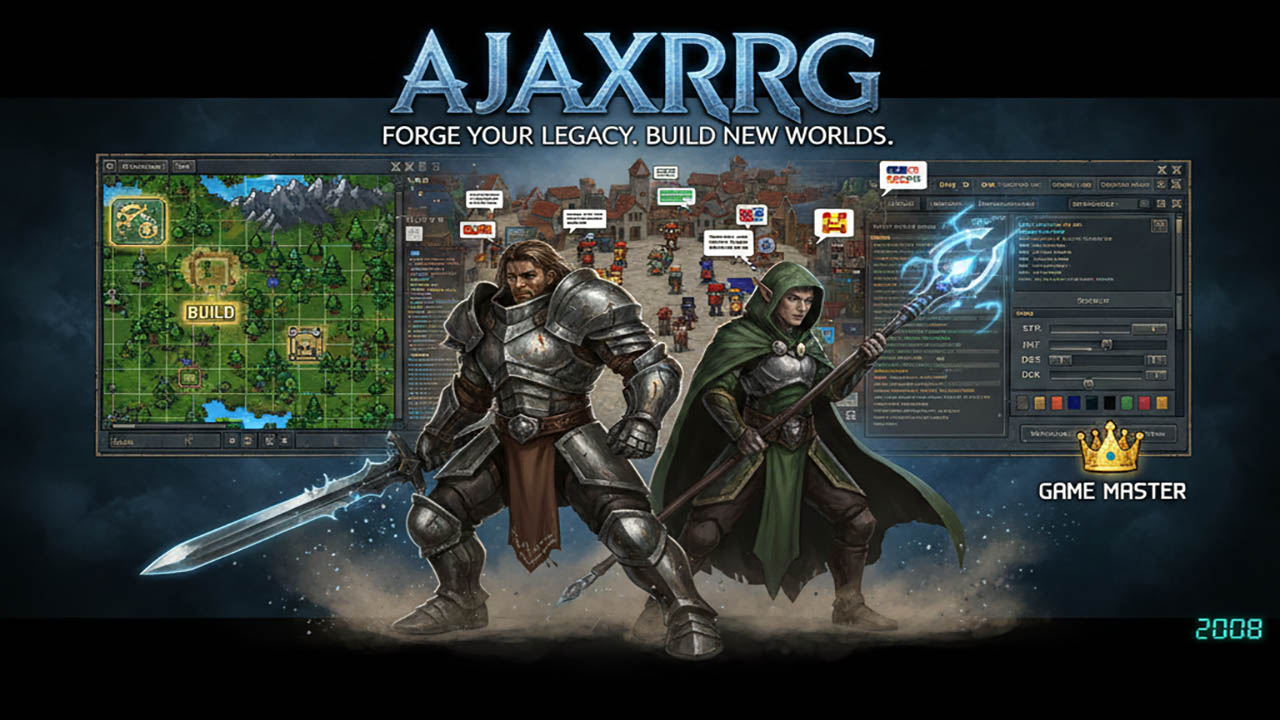
Dive into a living, breathing fantasy world right from your web browser with AjaxRPG! Choose your destiny as a mighty warrior or a cunning mage, customizing your stats to build the ultimate hero. Explore lush, tile-based landscapes filled with secrets, chat in real-time with fellow adventurers, and interact with a vibrant cast of characters—from wandering villagers to noble kings. Whether you're grouping up to explore deep forests or just socializing in the town square, AjaxRPG brings the classic top-down RPG experience to life with smooth 8-directional movement and instant multiplayer action.
But the adventure doesn't stop at playing—you hold the keys to the universe. AjaxRPG is the ultimate "Build Your Own MMORPG" toolkit, giving you the power to become the Game Master. Design your own maps, create custom NPCs, and write your own epic storylines. You aren't just a player; you are the architect of a new reality. Gather your friends, launch your server, and forge a new legacy in a world that is uniquely yours to command.
File Verification
AjaxRPG - Game Analysis Report
Metadata
| Name: | AjaxRPG |
|---|---|
| Version: | 0.9.35 |
| Total Files: | 138 (across all archives) |
| Total Size: | 1.28 MB (uncompressed: ~2.89 MB) |
| Created Date: | September 23, 2008 |
| Last Updated: | Version 0.9.35 (circa 2008) |
| Author: | Jeremy.J ( |
| Copyright: | Copyright (C) 2008 Jeremy.J |
| License: | GNU General Public License Version 2 (GPL v2) |
| Project URL: | http://sourceforge.net/projects/ajaxrpg/ |
| PHP Version: | PHP 4+ compatible (with modifications made to support PHP 4 in version 0.9.35) |
| Framework: | Joomla 1.5.0 Component |
| Database: | MySQL with MyISAM tables |
| Client Technology: | Java Applet (requires Java Runtime Environment) |
File Composition
| File Type | Count | Total Size (MB) | Purpose |
|---|---|---|---|
| .png | 50 | 0.036 | Game sprites, tiles, character graphics |
| .php | 47 | 0.145 | Server-side game logic, admin interface |
| .html | 12 | <0.001 | Basic page templates, directory indexes |
| .txt | 8 | 0.045 | Documentation (README, LICENSE, CHANGELOG, TODO) |
| .jar | 5 | 0.394 | Java applet client and dependencies |
| .zip | 5 | 2.053 | Component archives (admin/frontend files) |
| .inc | 4 | 0.177 | PHP include files (XML-RPC library) |
| .sql | 4 | 0.034 | Database schema and installation scripts |
| .xml | 2 | 0.003 | Joomla component manifest |
| .gif | 1 | <0.001 | Graphics |
| Total | 138 | ~2.89 | Complete package |
File Distribution Analysis:
- Graphics (36%): 50 PNG files + 1 GIF for game visuals
- Code (34%): 47 PHP files + 4 INC files for server logic
- Java Client (4%): 5 JAR files for client-side application
- Documentation (6%): 8 TXT files for project information
- Archives (4%): 5 ZIP files containing packaged components
- Other (16%): HTML, SQL, XML configuration files
Technical Architecture
Platform: Web-based, Browser-hosted
Frontend: Java Applet Client (JAR files)
Communication Protocol: XML-RPC over HTTP
Backend Framework: Joomla 1.5 Component Architecture
Session Management: Custom PHP session system with token validation
Real-time Features: Event-driven architecture using scheduled "gears" system
Key Dependencies:
- Apache XML-RPC (Java) - Copyright 1999, 2005 The Apache Software Foundation
- XML-RPC for PHP - Copyright Edd Dumbill (BSD License)
- Swing Layout (Java) - Copyright 2005-2006 Sun Microsystems
- swing-layout-1.0.3.jar
- ws-commons-util-1.0.2.jar
- xmlrpc-client-3.1.jar
- xmlrpc-common-3.1.jar
Game Overview
Innovative Concept: AjaxRPG is an ambitious web-based RPG creator and engine designed as a Joomla component. Rather than being a single standalone game, it's a framework that allows administrators to create and manage their own browser-based multiplayer role-playing games. Think of it as a "build your own MMORPG" toolkit that runs in your web browser using Java applet technology.
Historical Significance: This was a pioneering attempt to democratize MMORPG creation years before similar tools became mainstream.
Genre & Theme
Genre: Multiplayer Online RPG Engine/Creator
Theme: Generic Fantasy (Customizable)
Game Style: Tile-based, Top-down 2D perspective with real-time multiplayer interaction
Target Audience: Web developers and game masters wanting to create custom browser-based RPGs
Gameplay Mechanics
Character System
AjaxRPG implements a class-based character system with the following features:
Available Classes (Default Demo):
- Human Male
- Base HP: 35
- Base MP: 10
- Base STR: 20
- Base CON: 15
- Base DEX: 10
- Base INT: 15
- HP per level: 10
- MP per level: 2
- Human Female
- Base HP: 30
- Base MP: 15
- Base STR: 15
- Base CON: 10
- Base DEX: 15
- Base INT: 15
- HP per level: 8
- MP per level: 5
Character Attributes:
- HP (Hit Points): Health/Life points
- MP (Mana Points): Magic/ability resource
- STR (Strength): Physical power
- CON (Constitution): Endurance and defense
- DEX (Dexterity): Agility and accuracy
- INT (Intelligence): Magic power and mental abilities
Character Appearance System
The game features a sophisticated appearance system with 8-directional character sprites: North (N), Northeast (NE), East (E), Southeast (SE), South (S), Southwest (SW), West (W), Northwest (NW)
Available Character Appearances:
- Man (Boy) - Traditional male hero sprite
- Dog - Animal companion sprite
- Girl - Young female character
- Girl2 - Alternative female character
- King - Royal/noble character
- Old Man - Elderly character
Each appearance has unique directional sprites for smooth movement animation.
World & Map System
Map Features:
- Tile-based grid system (default demo: 20x20 map)
- Dual-layer rendering (layer1 and layer2 tiles)
- Walkable/non-walkable terrain designation
- Multiple map support with unique IDs
- X/Y coordinate-based positioning
Tile Types in Demo Map:
- Grass variations (grass, grass2, grass3, grass4, grass5, grass6)
- Water tiles (water1-7) - non-walkable
- Wood/floor tiles (wood1, wood3)
- Trees (tree1-4) - obstacles
- Rocks - obstacles
Map Objects:
The game tracks three types of objects that can appear on maps:
- Players - Human-controlled characters
- NPCs - Non-player characters with AI
- Enemies - Hostile entities
NPC System
NPCs use a template-based system with rich configuration options:
Demo NPC Example: "Small Dog"
- Appearance: Dog sprite
- Level: 1
- HP: 10, MP: 0
- STR: 5, CON: 5, DEX: 5, INT: 5
- Is Enemy: No
- Auto-walk: Yes (randomly wanders)
- Experience Gain: 0
- Respawn Delay: 60 seconds
NPCs can be configured to: automatically wander around the map, have custom stats and levels, provide experience when defeated, respawn after a set delay, and be friendly or hostile.
Movement & Control System
Movement Implementation:
- Grid-based tile movement
- 8-directional movement support
- Action interval system (prevents instant movement)
- Server-validated positioning (anti-cheat)
- Real-time position synchronization across clients
- "Last action time" tracking to control movement speed
Control Interface:
- Button-based directional controls (Up, Down, Left, Right)
- Mouse-click movement (planned for future version)
- Exit button for proper game closure
Communication & Chat System
Chat Features:
- Real-time console-based chat
- Broadcast messages to all players on the same map
- Event-driven message delivery
- Player online/offline status tracking
- Administrative universe-wide announcements
Session & Online Management
Session System:
- Secure token-based authentication
- Integration with Joomla user system
- Session timeout management (60 seconds of inactivity)
- Character online/offline state tracking
- Automatic cleanup of expired sessions via "gears" system
Universe States:
- Online: Players can connect and play
- Offline: Universe closed with custom message display
- Admin can disconnect all players when taking universe offline
Statistics & Monitoring
XML-RPC Statistics Tracking:
The game logs detailed performance metrics: method called, input/output data, data payload sizes, execution time (microsecond precision), and timestamp of each request. This allows administrators to monitor server performance and identify bottlenecks.
Event System
AjaxRPG uses a sophisticated event-driven architecture:
Event Types Include:
- Player movement
- Map object visibility changes (show/hide)
- Chat messages
- Character connections/disconnections
- Scheduled background tasks
Event Processing:
Events are queued with: unique event ID, session ID, timestamp, event name, parameters (serialized), and recipient targeting (specific players or broadcasts).
Administrative Features
Backend Administration Interface:
Administrators can manage: universe online/offline status, offline message customization, player characters and permissions, map editing and creation, tile management, NPC template creation, appearance definitions, player class configuration, debug mode toggles (client and server), and action interval timing adjustments.
Character Management:
Create/delete characters per user, access level permissions (admin levels), character selection system, and multiple characters per Joomla user account.
Development Status
Implemented Features (v0.9.35):
- Character creation with class selection
- 8-directional tile-based movement
- Map rendering with dual layers
- Real-time multiplayer support
- Chat system
- NPC templates with auto-walk
- Event system for real-time updates
- Session management and security
- Online/offline universe control
- XML-RPC statistics tracking
- Token-based form protection
- Admin backend interface
- Multiple map support
- Map object visibility system
- Gears (scheduled task) system
- Data integrity verification (partial)
Planned Features (Future Versions):
v0.9.36 (Immediate Next):
- Information overlay display on map
- Mouse-based movement integration
- Class and appearance selection during character creation
v0.9.37:
- Option to preserve data during component uninstallation
- Complete backend data editing forms
v0.9.38:
- Visual map editor tool
v0.9.39:
- Improved Java client look & feel
- PHP 4 compatibility refinements
- Component publication for user feedback
v0.9.40 (End 2008 target):
- Bug fixes and stable version release
v0.9.50 (First half 2009):
- Animated character and object movement
- Scripting system
- Inventory management
- Map transitions
v0.9.60 (Second half 2009):
- Combat system implementation
- Experience point system
- Item trading between players
- Shop/merchant system
Unscheduled Future Features:
- Java version detection applet
- Server-side logging system
- Java client debugging tools
- User preferences (server-stored)
- Client settings (local storage)
- Anti-cheat detection system
- Blacklist system (players and IPs)
- Data import/export functionality
- Client log upload to server
Database Schema
The game uses 13 MySQL tables with MyISAM engine:
- ajaxrpg_session - Session management
- ajaxrpg_map - Map definitions
- ajaxrpg_map_data - Tile data for each map position
- ajaxrpg_map_object - Objects placed on maps
- ajaxrpg_settings - Game configuration
- ajaxrpg_character - Player characters
- ajaxrpg_tile - Tile graphics registry
- ajaxrpg_npc_template - NPC definitions
- ajaxrpg_appearance - Character sprite sets
- ajaxrpg_player_class - Character classes
- ajaxrpg_player_class_appearance - Allowed appearances per class
- ajaxrpg_stats_xmlrpc - Performance statistics
- ajaxrpg_event - Event queue
Strengths & Innovations
Innovative Design Elements:
- Browser-based multiplayer RPG using proven Java applet technology (for its time)
- Modular Joomla component integration
- Flexible event-driven real-time communication
- Separation of concerns: tile data, map structure, and object layers
- Sophisticated appearance system with 8-directional movement
- Template-based NPC creation
- Built-in statistics and monitoring
- Customizable universe with admin controls
Well-Architected Features:
- Clean database schema with proper indexing
- Token-based security for forms
- Session timeout and cleanup automation
- Proper copyright attribution for dependencies
- Extensive TODO documentation showing thoughtful roadmap
Limitations & Considerations
Technical Limitations:
- Requires Java browser plugin (increasingly rare in modern browsers)
- Depends on deprecated Java Applet technology
- Tied to specific Joomla 1.5 architecture (older CMS version)
- MyISAM tables (no transaction support, older MySQL engine)
- French language mixing in some comments/variables
- Combat system not yet implemented in this version
- Inventory system incomplete
Era-Specific Technology:
This is a 2008-era project built on technologies popular at the time but now largely obsolete: Java applets (discontinued by most browsers), Joomla 1.5 (very outdated), and XML-RPC (largely replaced by REST APIs and WebSockets).
Summary
AjaxRPG is a remarkably ambitious open-source project that attempted to bring multiplayer RPG creation to the web browser in 2008. Rather than being a single game, it's a game engine and creation toolkit designed to let webmasters and game designers build their own custom MMORPGs that run entirely in a web browser. The project demonstrates sophisticated software architecture with its event-driven system, real-time multiplayer synchronization, and comprehensive administrative tools.
The demo universe included with version 0.9.35 shows a fantasy-themed RPG with various character types (humans, dogs, kings, old men), a pastoral map featuring grass, trees, and water, and wandering NPCs. Players would create characters, choose classes with distinct stat distributions, and explore the tile-based world together in real-time, chatting and interacting with NPCs.
While the combat, inventory, and progression systems remained unimplemented in this version, the foundation was clearly laid for a full-featured MMORPG engine. The extensive TODO list shows the developer's vision for animated movement, scripting, trading, shops, and complete RPG mechanics. The project's French-language comments suggest the developer was French-speaking (Jeremy.J), and the attention to detail in the database schema and event system reveals serious software engineering talent.
Unfortunately, as a 2008 project built on Java applets and Joomla 1.5, AjaxRPG is now a historical artifact representing the web game development practices of its era. The deprecation of Java browser plugins and the advancement of HTML5/WebGL technologies have made this approach obsolete, but the project remains an interesting study in browser-based game architecture and multiplayer RPG design.
For its time, AjaxRPG represented an innovative attempt to democratize MMORPG creation, making it accessible to webmasters with Joomla sites who wanted to offer custom multiplayer gaming experiences to their communities. The comprehensive feature set, thoughtful architecture, and extensive documentation show this was a serious project with significant development effort behind it.
Modern-Day Assessment & Conclusions
Current Viability
What This Codebase Is Good For Today:
- Educational Study - Excellent example of event-driven multiplayer game architecture and XML-RPC implementation for students learning game server design
- Historical Reference - Documents how browser-based MMORPGs were built in the late 2000s
- Database Schema Study - Clean, well-structured database design for tile-based RPG systems
- Architectural Patterns - Event dispatching, session management, and real-time multiplayer synchronization concepts remain relevant
- Salvageable Assets - The 50 PNG sprite files and tile graphics could be extracted for other projects
- Conceptual Framework - The game mechanics design (classes, NPCs, appearances) could inform modern RPG development
NOT Recommended For:
- Production deployment (severe security risks)
- Learning modern PHP (uses outdated practices)
- Active multiplayer gaming (technology stack is obsolete)
Requirements to Fire It Up
Minimal Setup (Highly Discouraged):
- PHP 4.x or 5.x (ancient versions)
- MySQL 5.0+ with MyISAM support
- Joomla! 1.5.x CMS installation
- Apache web server with mod_rewrite
- Java Runtime Environment 6 or 7 in browser
- Browser with Java plugin support (Firefox ESR ~52 or older)
The Problem: Finding a browser that still supports Java applets is nearly impossible. Chrome, Firefox, Safari, and Edge all removed support years ago for security reasons. Even if you found an old browser, running deprecated Java plugins exposes you to serious security vulnerabilities.
Modernization Requirements (PHP 8.4 + Modern LAMP)
Massive Refactoring Needed:
1. Client-Side Complete Rewrite (Estimated: 200-300 hours)
- Replace Java applet with HTML5 Canvas or WebGL (Phaser.js, PixiJS)
- Rebuild entire UI using modern JavaScript framework (React, Vue, or vanilla)
- Implement WebSocket for real-time communication (replace XML-RPC)
- Rewrite all client-side game logic in TypeScript/JavaScript
2. PHP Backend Modernization (Estimated: 150-200 hours)
- Update to PHP 8.4 syntax (remove deprecated functions, update class structures)
- Replace XML-RPC with RESTful API or WebSocket server
- Implement PSR-4 autoloading (replace custom includes)
- Add namespace support throughout codebase
- Update to prepared statements (already uses some, but improve)
- Implement proper dependency injection
- Add type hints and return types
- Replace register_globals dependencies (if any)
3. Framework Migration (Estimated: 100-150 hours)
- Decouple from Joomla 1.5 (completely obsolete)
- Either port to modern Joomla 4/5 OR rebuild as standalone app using Laravel, Symfony, or similar
- Rewrite authentication/authorization (Joomla-specific code)
4. Database Modernization (Estimated: 40-60 hours)
- Convert MyISAM tables to InnoDB (transaction support)
- Review and optimize indexes
- Add foreign key constraints
- Update table prefixes and naming conventions
- Implement migrations system
- Consider adding caching layer (Redis/Memcached)
5. Security Overhaul (Estimated: 80-100 hours)
- Implement CSRF protection properly (not just tokens)
- Add rate limiting for API endpoints
- Update password hashing (bcrypt/Argon2)
- Sanitize all inputs with modern methods
- Implement proper session management (HttpOnly, SameSite cookies)
- Add SQL injection prevention (use ORM like Eloquent or Doctrine)
- Validate and escape all outputs
Total Estimated Effort: 570-810 hours (14-20 weeks full-time)
Estimated Cost: $28,500 - $81,000 at industry rates ($50-100/hour)
Verdict: Building from scratch with modern tools would likely be faster and more cost-effective than refactoring this codebase.
Code Quality Assessment
Strengths:
- Clean database schema design with proper indexing
- Good separation of concerns (MVC-like structure)
- Comprehensive documentation and comments
- Event-driven architecture shows advanced planning
- Token-based security (ahead of its time)
- Proper copyright attributions
- Detailed TODO and CHANGELOG files
- Consistent coding style
Weaknesses:
- Mixed French/English in code (maintainability issue)
- No unit tests or automated testing
- Tight coupling to Joomla 1.5
- Hard-coded configuration values
- Limited error handling in places
- No logging framework (custom implementations)
- Session management could be more robust
Overall Code Quality Rating: 6.5/10
For 2008 standards, this is solid B-grade code. The architecture is thoughtful, and the developer clearly knew what they were doing. However, by modern standards, it lacks essential features like testing, dependency management, and framework-agnostic design.
What Worked Well:
- Clean architecture with logical separation
- Comprehensive database design
- Thoughtful security considerations (for 2008)
- Excellent documentation
Inherent Dangers of Running This Code
CRITICAL SECURITY RISKS:
- Ancient PHP Version Requirements - PHP 4.x and 5.x have HUNDREDS of known, unpatched security vulnerabilities
- Java Applet Execution - Running Java browser plugins is a primary malware infection vector
- Obsolete Joomla Version - Joomla 1.5 has critical SQL injection, XSS, and remote code execution vulnerabilities
- MyISAM Tables - No transaction support; database corruption risk
- Potential SQL Injection - While prepared statements are used in places, not consistently throughout
- Session Hijacking Risk - Session management lacks modern security features
- No HTTPS Enforcement - Plain HTTP communication can be intercepted
- XML-RPC Vulnerabilities - XML-RPC has numerous known attack vectors
- Outdated Dependencies - All Java libraries are from 2005-2008 era
- Unvalidated Input - Some user inputs may not be properly sanitized
Practical Dangers:
- Server compromise if exposed to internet
- Data breaches of user information
- Use as botnet node or crypto miner
- Malware distribution to players
- Complete database destruction
- Lateral movement to other servers on network
Risk Level: CRITICAL - DO NOT DEPLOY IN ANY PUBLIC-FACING ENVIRONMENT
\n Even running locally for testing poses risks. Only examine in isolated VM with no network access.
Innovation & Uniqueness Rating
Innovation Score: 8/10 (for its era)
Groundbreaking Elements (2008):
- Browser-based MMORPG creation toolkit (rare in 2008)
- Real-time multiplayer using web technologies
- Event-driven architecture for browser games
- Sophisticated tile engine with dual layers
- Built-in statistics tracking and monitoring
- Token-based security (JWT wasn't common until 2010+)
- Scheduled task system ("gears") for game automation
What Made It Special:
This wasn't just another browser game - it was a game creation platform. The vision of empowering non-programmers to create MMORPGs through a web interface was ahead of its time. Modern equivalents like RPG Maker MV (2015) for web and Manyland (2013) came years later.
Uniqueness Score: 7/10
While tile-based RPGs were common, wrapping one in a Joomla component with full multiplayer, an admin backend, and a Java applet client was innovative. The flexibility of the NPC template system and the sophisticated appearance system with 8-directional sprites showed attention to game design details often lacking in hobby projects.
Historical Significance:
AjaxRPG represents a transitional period in web gaming history - after Flash games but before HTML5 Canvas. It chose Java applets (doomed technology) but implemented them thoughtfully. Had this project launched 3-4 years earlier or pivoted to Flash, it might have gained significant adoption.
Historical Significance:
AjaxRPG represents a transitional period in web gaming history - after Flash games but before HTML5 Canvas. It chose Java applets (doomed technology) but implemented them thoughtfully. Had this project launched 3-4 years earlier or pivoted to Flash, it might have gained significant adoption.
Final Recommendation
For Developers
Study Value:
- Excellent architecture reference
- Well-designed database schema
- Event-driven patterns
- Token-based security concepts
Don't Modernize:
Effort to update exceeds building new with Phaser.js + Laravel + WebSockets.
For Historians
Historical Artifact:
- Pre-HTML5 web gaming era
- MMORPG democratization attempt
- Comprehensive documentation
- Ambitious feature planning
For Game Designers
Design Reference:
- Class system templates
- Tile-based mechanics
- NPC behavior patterns
- Sound game design principles
For Security Researchers
Case Study Value:
- Dependency rot example
- Technology stack collapse
- Importance of updates
- Sustainable tech choices
Bottom Line
AjaxRPG was an admirable and innovative project that deserved success but was built on a technology stack (Java applets, Joomla 1.5) that collapsed within a few years. The comprehensive documentation and thoughtful architecture demonstrate serious game development expertise.
Verdict: Now a historical curiosity and educational resource rather than usable software. The ideas and architectural patterns remain valuable, but the implementation belongs in a museum.
Final Ratings
| Historical Value | ★★★★★ 5/5 |
|---|---|
| Code Quality (2008 Standards) | ★★★★☆ 4/5 |
| Code Quality (Modern Standards) | ★★☆☆☆ 2/5 |
| Innovation | ★★★★☆ 4/5 |
| Security | ☆☆☆☆☆ 0/5 |
| Completeness | ★★★☆☆ 3/5 |
| Overall Grade | B Excellent concept, obsolete implementation |
available
Security Warning
Running many of the scripts in this archive on a live server presents a serious security risk. These projects were created before modern hardening practices and may contain vulnerabilities that can compromise your system.
We strongly recommend using this code for reference and analysis only, or in isolated local environments. By downloading these files, you accept full responsibility for their use.